Showing posts with label Macros. Show all posts

Thursday, May 16, 2013

Fish Out of Water


The little stream continued to battle with the Andaman Sea. High tide pushed water into the stream every time a big jolly wave lashed at the shore. And when a gentle wave followed suit, the stream melted into the sea. I walked along the stream to look for its source when I saw them. Mudskippers. They were everywhere. Brown. Speckled. Some golden. Small and big. Everywhere! Dozens of them waddled at the edge of the stream lazily, leaping away when I stopped to observe them. While some stayed at the top edge of the water with just their eyes popping out, others stuck to the bottom of the stream. The source turned out to be a small pond, with more denizens - Hermit Crabs, tadpoles and plenty of little fish. I found the driest spot by the edge of the water and settled down to observe and photograph them, up close.

Mudskippers are fish out of water, literally.They are completely amphibious fish and belong to one of the largest families of fish, Gobiidae. They have the ability to breathe through their skin and also the lining of their mouth. This means that they have to keep their skin moist at all times and that factor limits their habitat to humid and swampy areas. Mudskippers have an enlarged gill chamber which functions like an oxygen cylinder by preserving a bubble of air, helping them breathe while they are out of water. This helps them survive and adapt well to intertidal zones and mangroves.
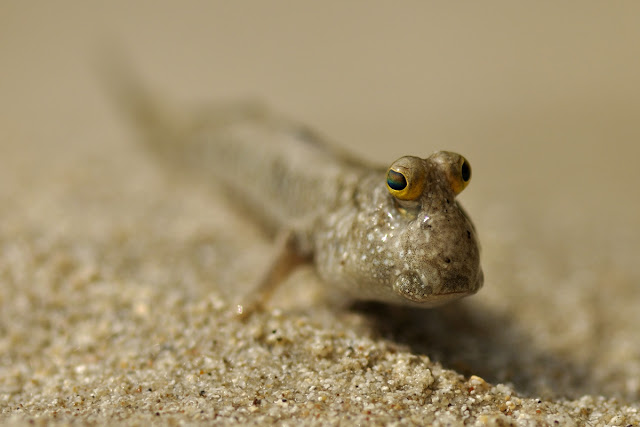

While I sat there, taking in their looks and behavior, they approached me slowly, one skip at a time. A few were just an inch away from me. They were unbelievably curious and bold, staring at me with those big, bulging eyes. And, no, I am not imagining things, they really do stare, hard. Very aware of their close proximity to me, I slowly moved my arm to adjust camera settings and as things turned out, they didn't like that at all. They all leaped away in an instant. Skip up close, stare, jump away at the smallest movement. Repeat. The first few times this happened, an eerie, unsettling memory those little green Compsognathus dinosaurs in the Jurassic Park movie series crept into my head. Dismissing vacuous thoughts of mutant Mudskippers, I went back to work.


Mudskippers use their pectoral fins to walk on land, in a type of motion that resembles skipping. They use these fins to propel themselves ahead, to hop or jump. In all fish, pectoral fins occur in a pair, and function as forelimbs. And in a highly developed state, these fins enable some species to do very specific actions - they help Flying Fish in their flight and Mudskippers in their walking motion.  Male Mudskippers use their dorsal fins for displays during the breeding season and for solving tiffs.


Mudskippers spend a considerable amount of time outside water, on and in the mud. Their social interactions happen outside of water - mating displays, territorial fights, feeding, etc. While I mostly saw them just lazing around, there were a few of them here and there, fighting and feeding. Mudskippers mainly feed on insects, tiny organisms in the mud and small crustaceans. They dig deep burrows into the mud and stay in there at high tide, to avoid predators. They also lay their eggs in these burrows and the males diligently take care of their eggs by bringing mouthfuls of oxygen from the surface till they hatch.


However, the one memory of Mudskippers that will stay with me are those huge, bulbous, protuberant eyes on the top of their blunt heads. And when they sit around staring at you up close, its hard not to notice those fabulous colors -Turquoise, Yellow, Green, Red, Ochre, Black, Gold.


Their eyes are close set and movable. They pull either one or both their eyes into their heads and push them out in a brisk motion, as fast as one can bat their eyelids. It was fascinating to watch their eyes and the things they could do with them!


At some point around then I realized that I had lost track of time. My watch told me I had been there, watching these little guys, for almost two hours. But, they were not done with staring at me yet and I wasn't going to be bored anytime soon. Yet, the relentless heat and humidity on the island took a toll on me. All I craved for was to go sit in the sea, with only my head popping out, just like my new found friends. I bid adieu, thanking them for sharing their noon with me, and so graciously allowing me a peek into their peaceful lives.


Monday, September 10, 2012

Quid pro quo

It is a bustling, vivacious world out there, is a thought I cannot evade every single time I am out in the wild. One could walk ten steps and observe a hundred different things happening at the same time. At sundown, a huge flock of Bee-eaters chirping, or a lone Pitta calling out mean the same thing - they are prepping to roost and retire for the day. But, that Nightjar clucking aloud at the same moment has just begun its day. A skittish Bulbul perching on a shrub could be very random behavior, but a Mormon picking a particular shrub to settle down on could mean something else. A bunch of Ants going up and down a blade of grass are definitely there for a reason and so is that Calotes hanging around an Ant's nest. For every unrelated event, there are a dozen related behaviors and for every behavior we think we understand, there are a dozen that we don't see or comprehend.

Relationships in the wild are mostly either obligate (where both species completely depend upon each other) or facultative (where they can, but they don't have to live together).

I once came across dozens of little insects, each the size of a mustard, clumped together under a leaf. They had some pretty red ants for company. I was later told that they are sap sucking insects called Aphids or Plant Lice. They are probably one of the most destructive insect pest species. The red ants belonged to the genus Camponotus and are commonly called Carpenter Ants. Aphids pierce leaves and feed on sap. Excess sap concentrates as honeydew, which attracts ants. In a display of Mutualism, the ants provide aphids protection from predators.The next time you see plant lice on a leaf in your garden, look around before you toss the leaf out. You might see the entire life cycle of a species on that very leaf!


Ants and Aphids


Mutualism is a co-operative interaction between two organisms of different species where they biologically interact and derive some positive benefit out of the interaction. However, this is not an obligatory relationship. Both species can function normally without this relationship. 

Watching ants and aphids peacefully co-exist together built enough curiosity in me to observe ants more. And that is how I was introduced to Mealybugs and Treehoppers. Mealybugs are scale insects, considered as pests since they feed on plant juices and can induce leaf drop when they occur in large numbers. They become very serious pests in the presence of some ants, as these ants protect them from predators - again, a display of mutualism.

Ant tending to a Mealybug


Ants and a Mealybug

Treehoppers belong to the family Membracidae, a group of insects related to Cicadas and the Leafhoppers. Some treehoppers have also developed mutualistic relationships with Wasps.


Ant tending to a Treehopper

Unlike mutualism, Parasitic relationships are non-mutual, where one organism benefits at the expense of the other. Mistletoe, strangler figs, leeches, fleas fall into this category.
Insects like fleas are external parasites, they are wingless and have mouthparts adapted for piercing skin of mammals and birds to suck blood. Leeches are also blood suckers, they feed on blood from vertebrate and invertebrate animals. 

Some members of the Mistletoe family are partial parasites. When birds like Flowerpeckers feed on the fruit of this plant, a sticky substance present in the fruits ensures that the seeds get stuck to their body. To get rid of these seeds, the birds rub their body against a tree, thus enabling seed dispersion - the roots penetrate the branch of the tree and the plant is born. The plant has green leaves and can photosynthesize, but absorbs nutrients from the host tree instead. Although the Mistletoe is a partial parasite, it is beneficial to the ecosystem, with a wide variety of species depending on the fruits. The plant is also a larval host for the very pretty butterfly, Common Jezebel.


Mistletoe Flowers

I find Strangler Figs fascinating, I think they add charm to a forest. Mostly found in dense, tropical forests, these plants begin life as epiphytes. Birds and other arboreal animals act as seed dispersers for these Ficus plants and they grow on top of other trees, by germinating in crevices on branches. The seedlings then begin their journey downwards, looking for necessary nutrients and simultaneously grow upwards into the sky, in the quest for sunlight. In the process, the original host tree is enveloped and often dies. As they grow, the fractals these roots and branches assume look eerily beautiful. I have seen the most spectacular specimen of Strangler Figs in Bhadra Tiger Reserve and Jim Corbett National Park.  


Strangler Fig from Bhadra

A Symbiotic relationship, on the other hand, takes place between two species where they completely depend on each other for survival.
Symbiotic relationships can be broadly classified into Ectosymbiosis - where one organism lives on another (mistletoe, lice, cleaner fish) and Endosymbiosis - where one partner lives inside the other (zooxanthelles in corals, lactobacilli in humans)

Lichen, for example, is a composite organism which is formed as a result of a symbiotic relationship between fungi (mycobiont) and a photosynthetic partner, usually green algae (phycobiont). Algae can photosynthesize by virtue of being a plant. Carbohydrates are produced during photosynthesis, which in turn serve as food for the fungi. 


Lichen

Lichens (rock flower) are some of the oldest living organisms on Earth and can survive in varied climates and altitudes. They grow on any undisturbed surface that receives ample light - leaves, branches, bare rocks, walls and exposed soil surfaces. Many lichens are vulnerable to environmental disturbances and their growth is inhibited in such cases. So, they can be observed to assess air pollution. They are used to prepare dyes, masalas and some medicines too.

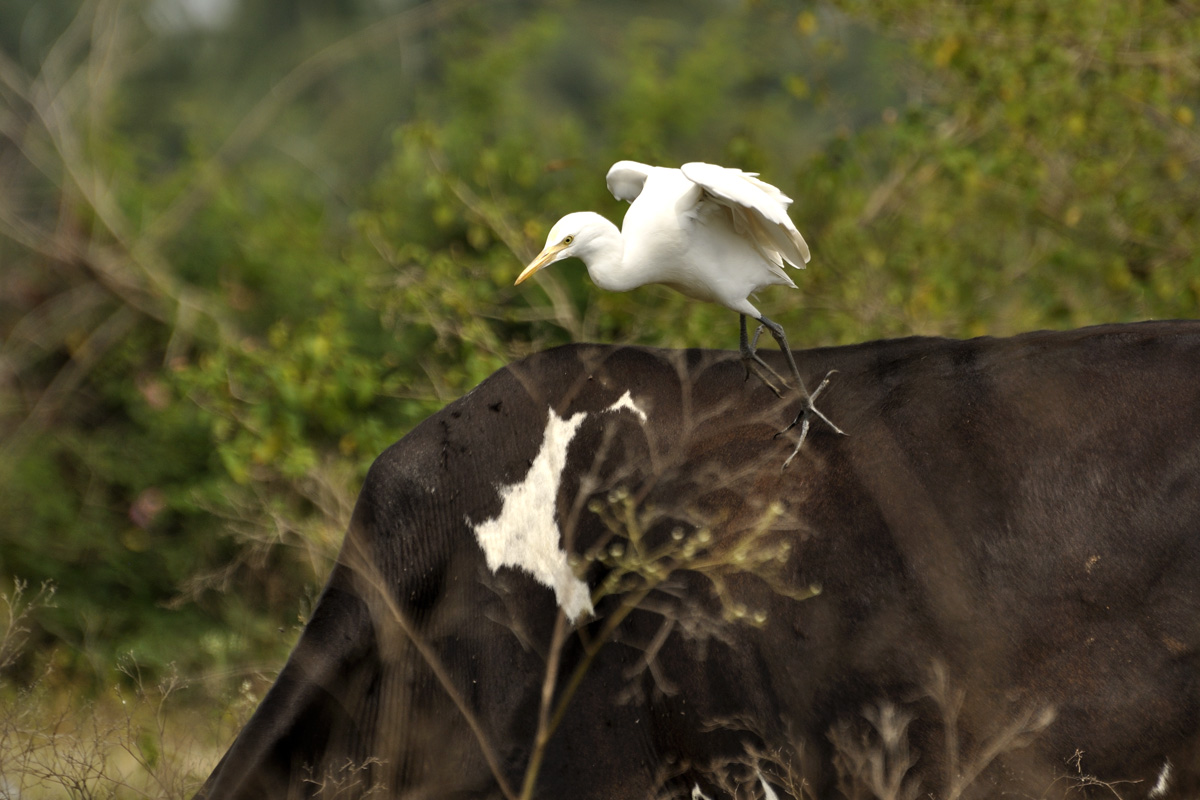
Cattle Egrets following a herd of grazing cattle is a common sight in most suburban parks and villages. In forests, we see these Egrets around herds of Elephants, Deer and Gaur. They spend time around these large mammals feeding on insects and other small prey that are disturbed while they graze.
This type of a relationship is called Commensalism. The word originates from the term 'Commensal' which means 'sharing of food'. Here, one organism benefits but the other doesn't - and it is caused no harm either. 

Cattle Egrets with a herd of Elephants

All bonds in the ecosystem are delicate and sensitive, they hang by a thin silken thread. The loss of one species in a relationship can spell disaster for the other species too. They give and take, but just the right amount, to maintain and enrich that critical equilibrium. While we know of and understand some of these connections and inter-dependencies between species around us, there are many that aren't even visible to the naked eye, that are still being studied. Many of these relationships have heavily influenced evolution.

We humans are social in nature and live in a sea of relationships - we are born into many, we build several, we are forced into some, we love being in a few that we care about and hate being in those we become hostages of. We are capable of developing close bonds with anything or anyone we spend a considerable amount of time with. We are constantly wriggling in and out of relationships, pretty much like all other forms of life we share this planet with. However, there is a difference. Humans can never achieve the kind of complexity in relationships that non-human forms of life can.


P.S Thank you, Karthik for helping me put mind and matter in a reasonable order :)