We were busy looking for Treepies and Trogons when the call came. A King Cobra had been sighted in a farm and the residents of a nearby house wanted it to be relocated to the forest. The ARRS team was off to rescue and release the King. Did we want to go along and watch? Yes, we said. A huge YES.
Belagundi is a quaint, pretty village a little away from Bidri, about 25kms from Agumbe. As we drove down the ghats, we saw Prashant, Ajay and Dheeraj stop to pick up a semi-dead Ornate Flying Snake from the road. It was a heart-rending sight to watch the tiny, beautiful snake wriggling on the road. Its slender body had been crushed by a vehicle. We drove on, the Seetanadi river flowing along the road, lush green forests and areca plantations dotted the landscape. At Belagundi, we got off the vehicle and walked into a field, a small group of 10 odd people had gathered there, mostly local residents and some workers of the farm. They led us to a tiny stream by the edge of the farm and pointed at the location where the King had been resting the last two days, but now, only the tip of the tail was visible, the King had moved into some shrubs by the stream.

As the ARRS team moved around, to get a better view of the King, it struck me that these people had waited two full days to call and ask for help after they spotted the King. There was a house about 50 metres away from where the King had been spotted, there were children in that house. Yet, they waited, patiently, without disturbing their guest. Moreover, everyone there was concerned that the King could be injured as they didn't see it move around at all. Prashant explained that it is a possibility, or, it might be resting after a heavy meal - a big rat snake maybe? They would be able to confirm only after they see the King in its entirety. The concern they had for the King's well-being was touching. My heart swells with pride when I think of how tolerant and respectful these folks were about wildlife.
The King Cobra is worshipped in these parts, these people revere the snake. They will cause no harm to the longest, most venomous snake in the world.

Once they were able to locate the exact position of the King, they got to work. First, they cleared up the area where they would eventually bring the King out of the shrubs, so that they don't have any obstructions. All tiny bushes were removed, working space had been created. The team advised everyone watching to maintain a safe distance, not move around and maintain silence. While one person kept a constant watch on the head of the King, another held the tail and with a mild jerk, prodded the snake to move.

The King moved and we could now see more of its body, but no one had a clue of the actual length and size yet. More nudging, coaxing, pulling and the King was finally out. I gasped aloud, but I wasn't alone - a collective gasp from the crowd greeted an irritated King. A glinting blackest-black body with golden-bronze bands and a rich yellow underbelly, the 10 foot long juvenile male was a stunner, albeit in a compromised position at that moment.


He constantly flicked his tongue and moved around, clearly trying to find a way out of this ugly situation. Accuse me of being anthropomorphic, but who wouldn't get intimidated, scared and angry if they were being taken captive? Prashant held on to the tail, a tight grip and his attention was entirely on the movements of the snake. Dheeraj tried to cover the head of the snake with a bag that had an opening like a net, so that the snake would be forced to slither in and could be captured.
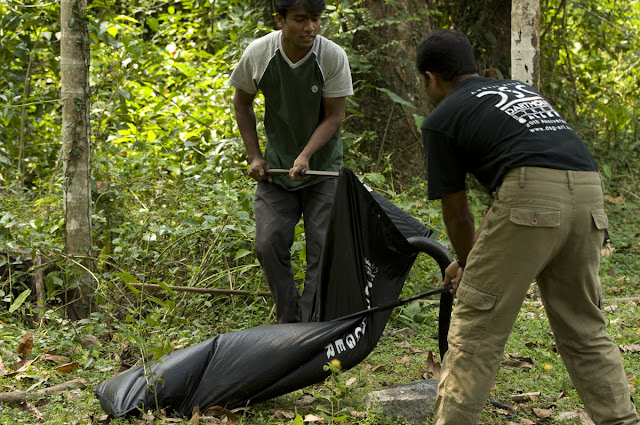
The first couple of attempts to get the King in the bag didn't work and that's when he started showing signs of agitation. He raised his hood and that magnificient pose is something I will remember all my life. The crowd watching this capture was enveloped in silence, no one moved, all the murmuring died down.

And then it happened, the King bared his fangs.

A sight that filled me with amazement, fear, respect, worry - all at once. Amazement, because I've always associated sights like these with Austin Steven's documentaries. Fear, well, the image explains it all. The King would not give up and go down, he would fight his way through this, Respect. Once released, would it find a safe spot away from human intervention? Would it be able to survive on its own in a new place? Worry.

Prashant and Dheeraj were finally able to coax the King into the bag. Once the snake was in, a knot was secured, ready to be relocated. They worked together as a team with superb precision and composure.

The King was then weighed and he turned out to be 8.9 kilograms. We all headed back towards the nearby forest patch, adjoining the Someshwara Wildlife Sanctuary. After ensuring that the habitat was perfect for the King Cobra and that it was a safe distance away from any human intervention, the snake was released in the forest.
A relatively simpler task now - the knot was removed, some coaxing and the King headed out of the bag into its new home, or maybe it was the same old home, we will never know.


Once he was out of the bag, he moved away, graciously, down the forest path and into the leaf litter far away from us.

The entire rescue-release operation was carried out very professionally by the ARRS team. They were meticulous and followed all procedures to the last detail. Prashant said this was one of their simpler, easier rescues. Now, try and imagine a King being rescued from a well, or from a house. Goosechills.
The love-hate relationship between humans and snakes is something we all see everyday around us. A Rat Snake in the local park gets mistaken for a venomous snake and is beaten up by an angry mob. An Indian Cobra that wanders into a township meets the same fate. Russel's Vipers get crushed under wheels all the time. Snakes are seen as bad and dangerous creatures, as villians. For most people, the first instinct upon seeing a snake is 'kill it'. Ironically, snakes are worshiped by almost all communities through the length and the breadth of the country. Yet, when the same people encounter a live one, things change drastically. Numerous and varied religious superstitions - mostly negative ones - about snakes definitely don't help the situation.
On many occasions, people take the help of trained/experienced snake rescuers, who capture these snakes and release them in nearby jungles. The snakes live to see another day, but it is impossible to say that these relocated snakes survive. In a new, unknown location, with no idea of what kind of prey is available, disoriented, many snakes perish. If they do manage to find food, they need to deal with other resident snakes, who may not be too kind to their new visitor. So, the snakes are at the receiving end, always.
We can only hope that with more awareness, humans will start treating snakes with the respect they deserve and will let them live. We need these beautiful creatures, the ecosystem needs them, to maintain a balance. They don't need us.
P.S. Thanks Arati Rao for the title!
Belagundi is a quaint, pretty village a little away from Bidri, about 25kms from Agumbe. As we drove down the ghats, we saw Prashant, Ajay and Dheeraj stop to pick up a semi-dead Ornate Flying Snake from the road. It was a heart-rending sight to watch the tiny, beautiful snake wriggling on the road. Its slender body had been crushed by a vehicle. We drove on, the Seetanadi river flowing along the road, lush green forests and areca plantations dotted the landscape. At Belagundi, we got off the vehicle and walked into a field, a small group of 10 odd people had gathered there, mostly local residents and some workers of the farm. They led us to a tiny stream by the edge of the farm and pointed at the location where the King had been resting the last two days, but now, only the tip of the tail was visible, the King had moved into some shrubs by the stream.

As the ARRS team moved around, to get a better view of the King, it struck me that these people had waited two full days to call and ask for help after they spotted the King. There was a house about 50 metres away from where the King had been spotted, there were children in that house. Yet, they waited, patiently, without disturbing their guest. Moreover, everyone there was concerned that the King could be injured as they didn't see it move around at all. Prashant explained that it is a possibility, or, it might be resting after a heavy meal - a big rat snake maybe? They would be able to confirm only after they see the King in its entirety. The concern they had for the King's well-being was touching. My heart swells with pride when I think of how tolerant and respectful these folks were about wildlife.
The King Cobra is worshipped in these parts, these people revere the snake. They will cause no harm to the longest, most venomous snake in the world.

Once they were able to locate the exact position of the King, they got to work. First, they cleared up the area where they would eventually bring the King out of the shrubs, so that they don't have any obstructions. All tiny bushes were removed, working space had been created. The team advised everyone watching to maintain a safe distance, not move around and maintain silence. While one person kept a constant watch on the head of the King, another held the tail and with a mild jerk, prodded the snake to move.

The King moved and we could now see more of its body, but no one had a clue of the actual length and size yet. More nudging, coaxing, pulling and the King was finally out. I gasped aloud, but I wasn't alone - a collective gasp from the crowd greeted an irritated King. A glinting blackest-black body with golden-bronze bands and a rich yellow underbelly, the 10 foot long juvenile male was a stunner, albeit in a compromised position at that moment.


He constantly flicked his tongue and moved around, clearly trying to find a way out of this ugly situation. Accuse me of being anthropomorphic, but who wouldn't get intimidated, scared and angry if they were being taken captive? Prashant held on to the tail, a tight grip and his attention was entirely on the movements of the snake. Dheeraj tried to cover the head of the snake with a bag that had an opening like a net, so that the snake would be forced to slither in and could be captured.

The first couple of attempts to get the King in the bag didn't work and that's when he started showing signs of agitation. He raised his hood and that magnificient pose is something I will remember all my life. The crowd watching this capture was enveloped in silence, no one moved, all the murmuring died down.

And then it happened, the King bared his fangs.

A sight that filled me with amazement, fear, respect, worry - all at once. Amazement, because I've always associated sights like these with Austin Steven's documentaries. Fear, well, the image explains it all. The King would not give up and go down, he would fight his way through this, Respect. Once released, would it find a safe spot away from human intervention? Would it be able to survive on its own in a new place? Worry.

Prashant and Dheeraj were finally able to coax the King into the bag. Once the snake was in, a knot was secured, ready to be relocated. They worked together as a team with superb precision and composure.

The King was then weighed and he turned out to be 8.9 kilograms. We all headed back towards the nearby forest patch, adjoining the Someshwara Wildlife Sanctuary. After ensuring that the habitat was perfect for the King Cobra and that it was a safe distance away from any human intervention, the snake was released in the forest.
A relatively simpler task now - the knot was removed, some coaxing and the King headed out of the bag into its new home, or maybe it was the same old home, we will never know.


Once he was out of the bag, he moved away, graciously, down the forest path and into the leaf litter far away from us.

The entire rescue-release operation was carried out very professionally by the ARRS team. They were meticulous and followed all procedures to the last detail. Prashant said this was one of their simpler, easier rescues. Now, try and imagine a King being rescued from a well, or from a house. Goosechills.
The love-hate relationship between humans and snakes is something we all see everyday around us. A Rat Snake in the local park gets mistaken for a venomous snake and is beaten up by an angry mob. An Indian Cobra that wanders into a township meets the same fate. Russel's Vipers get crushed under wheels all the time. Snakes are seen as bad and dangerous creatures, as villians. For most people, the first instinct upon seeing a snake is 'kill it'. Ironically, snakes are worshiped by almost all communities through the length and the breadth of the country. Yet, when the same people encounter a live one, things change drastically. Numerous and varied religious superstitions - mostly negative ones - about snakes definitely don't help the situation.
On many occasions, people take the help of trained/experienced snake rescuers, who capture these snakes and release them in nearby jungles. The snakes live to see another day, but it is impossible to say that these relocated snakes survive. In a new, unknown location, with no idea of what kind of prey is available, disoriented, many snakes perish. If they do manage to find food, they need to deal with other resident snakes, who may not be too kind to their new visitor. So, the snakes are at the receiving end, always.
We can only hope that with more awareness, humans will start treating snakes with the respect they deserve and will let them live. We need these beautiful creatures, the ecosystem needs them, to maintain a balance. They don't need us.
P.S. Thanks Arati Rao for the title!
** I own the copyright to all the images in this post. Please do not re-use any of these images without my permission.