Showing posts with label Trip. Show all posts

Monday, May 23, 2011

The King And I


I wrote this as a guest post for Prashanth's blog Payaniga upon its five year completion. It then appeared in the Clay blog too. Now, its here. 


My first memory of Agumbe is from a school trip to the Western Ghats. I was in class 8 and the famous Agumbe sunset was to be the highlight of the trip. Heavy rains and a landslide played spoilsport that year and Agumbe was moved to the ‘visit someday’ list. 15 years later, my wish came true. Dilan Mandanna, popularly known as Mandy, was going to organise a two day trip, with accommodation arrangements at the Agumbe Rainforest Research Station (ARRS). I simply had to sign up. I could finally put my newly acquired macro lens to some good use. After a successful leopard-tiger-elephant-hornbill-falcon sighting in Kabini the same week, I was looking to achieve nirvana with a sighting of the King.

Agumbe is a beautiful little village that sits on a plateau on top of the Someshwara Ghat, 643 meters above sea level. Surrounded by luscious green rainforests, it is known as ‘Cherrapunji of the South’ for a reason, it gets an annual rainfall of up to 11,000 mm. Agumbe is home to all the Western Ghats rainforest species of trees, mammals, birds, insects, frogs and snakes. However, the regal King Cobra, the world’s longest venomous snake is the King of the jungle in these parts.

A mad dash across the Majestic bus stand and a rickety 10 hour bus drive took me to a very rainy and wet Agumbe early in the morning. It had rained there all night. Aching muscles were forgotten the second Mandy announced that he had seen a male King the previous evening and was quite sure we’d be able to see him again. After dumping our bags and donning leech socks, we headed out to find the King.

His Highness was resting there, by the side of the forest path, right outside the bushes - 10 feet long, a rich brown, his scales glistening with raindrops, body all curved up as if to camouflage the inimitable length. He had devoured a heavy meal the previous evening and didn’t seem too keen to move, he just kept a watchful eye on us. In all my imagination, I had envisioned the King to be a spectacular snake, but nothing could have prepared me for this sighting. Goose bumps. Breathlessness. Loss of speech. Fear. Respect. I felt a mix of everything. I just stood there, gaping, with my mouth open. The beauty of the King is incomparable. The sound of a camera shutter next to me brought me back to reality, I had a camera in my hand to make an attempt to freeze this moment. Photographing the King is humbling, you are fully aware that you can do no justice in saving that intimidating stare for posterity, yet, you just go click-click-click.


The King Cobra has a striking distance of 2 m, around 7 feet, they are fast and agile. When threatened, the King raises its upper portion of the body, around 4-5 feet, so it basically looks at you straight in the eye and gives out a hiss that’s almost a growl, before doing its business. But, the King doesn’t like to bite. As much as possible, they avoid confrontation, they bite only when cornered or provoked. Before I forget, there is no antidote to a King Cobra bite.

ARRS was set up by Romulus Whitaker and has been operational since 2005. Many herpetologists, conservationists and researchers work on their projects based out of this research station. ARRS helps out in King Cobra rescues around the region. Though King Cobras are revered, they’re prone to some harm from humans when they venture into human settlements. Among many other projects, the King Cobra Radio Telemetry Project is currently operational here. With the help of telemetry, the researchers study snake movements. They record daily and seasonal activity patterns of King Cobras which helps in understanding their behaviour and eventually, in conserving this flagship species. The ARRS has a common dining area and common bathrooms. Serve your own food, wash your plates, don’t leave behind any plastic and give the staff their space to work is the way of life if you are a visitor.

It kept raining the entire day and we headed out to look for the King’s courtiers. A Green Vine Snake clung to a twig, completely camouflaged. Our presence brought out the black and white under its scales, a sign of aggravation.


A Malabar Pit Viper sat pretty in the bamboo, only a watchful eye can spot it, the shiny yellow scales give it away. It curls up into an S shape, defensive, its striking position.


A few steps ahead, an incredibly cute baby Nilgiri Keelback (Beddome’s Keelback) greeted us.


At every step we met wondrous new creatures - frogs, caterpillars, dragonflies, damselflies, butterflies.

caterpillar of a moth belonging to the Limacodidae or Euclidae family

The flora and fauna is so rich that you can spend an entire day photographing things at a single spot and you would still not be done with it.


A Malabar Trogon called for its partner, Yellow Browed Bulbuls zipped past our head. A Paris Peacock skimmed along, a Red Helen followed course. A Malabar Giant Squirrel dropped half eaten figs on our heads. A Crested Serpent Eagle called, gliding high up in the sky. I was in paradise.

Red Helens

Red Pierrot


White Bellied Treepies called out to us, so did Malabar Grey Hornbills. We went crawling across a huge field to shoot Malabar Larks and they took off before we got our best shots.


One evening, we made a trip to the Jogi Gundi falls. We walked under trees that made us feel like we are a few cms long, climbed over fallen trees, stepped over rocks, slipped down some leaf litter and reached a lovely waterfall with creamy white water gushing down the rocks. 


Green colored moss-laden rocks, wild orchids, lizards and frogs added to the beauty of the scene.

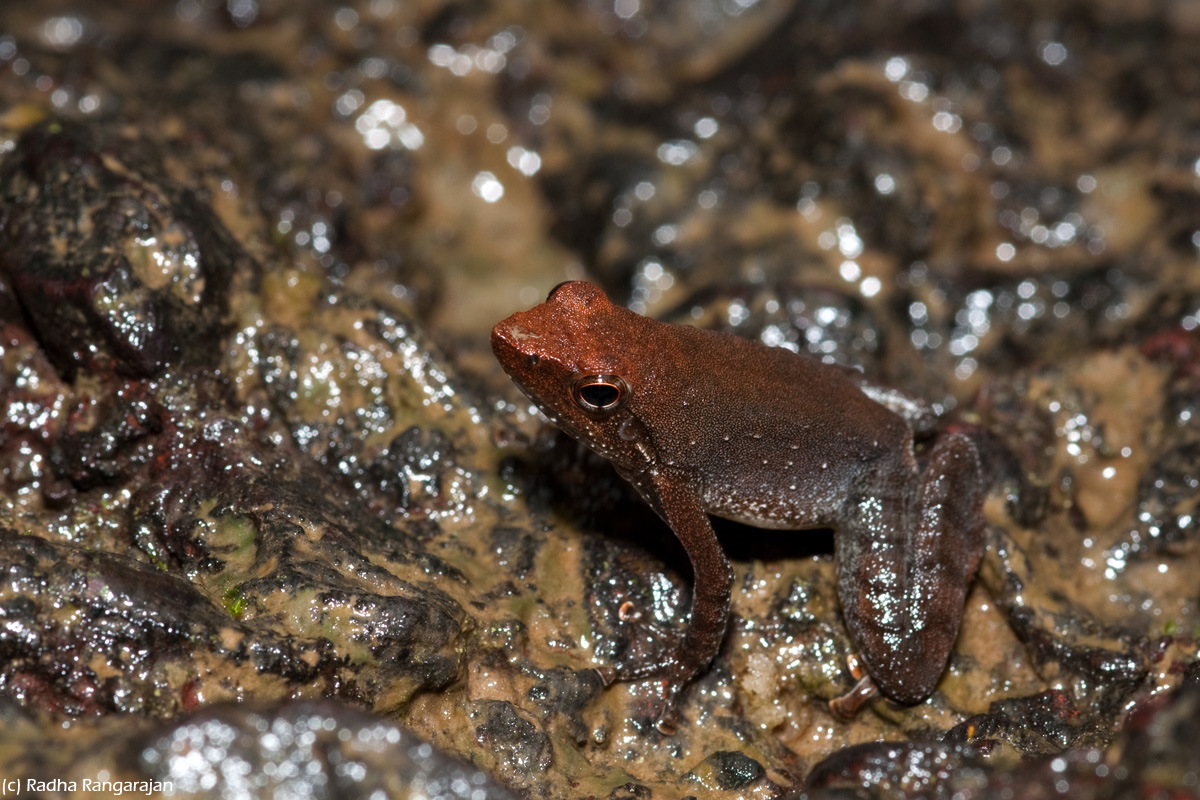

Micrixalus saxicola


And leeches. They were everywhere, crawling up our leech socks till we flicked them away, on our bags, cameras, there’s no getting away from them. The only way to not let them bother you is by not paying them any attention, alas, I am yet to reach that stage. I’ve had my share of experiences with leeches in Valparai, but the sheer number of leeches here was distracting. Much to the amusement of everybody in the group, a leech made its way to my camera neck-tag and then on to my cheek and gave me a peck before I managed to flick it away. As morbid as it sounds, yes, I’ve been kissed by a leech!

It was a cloudy, rainy day and we didn’t expect to see the Sun set, but we still went along to the sunset point to check out the view. As expected, the clouds had taken over the valley and every time they drifted apart, I tried to get a couple of images. Finally, the shy Sun made a brief appearance before the clouds took over completely.


If you are staying at the ARRS, a night walk is a must. Agumbe is an entirely different person at night. It gets insanely dark and all kinds of creatures are up and about. Armed with torches, we set out to look for snakes, scorpions, tarantulas and frogs. One of the first things we heard was a female Sri Lanka Frogmouth calling and we followed its call for quite some time before we spotted the elusive beauty. Mandy told us that no Frogmouth images had ever been made in Agumbe, our records of the sighting would be the first.


Typical to rainforests, you can find exotic fungi at every step.


A vine snake was hanging around the evening before we left, it bid us adieu.


It was pack-up time already. We drove past ‘Dodda Mane’, Malgudi Days was filmed here and the ancient bungalow was the home of the endearing little Swami. On the way back to the ugly urban jungle, I promised myself that I would return to Agumbe, for a longer trip, knowing that no amount of time spent here can be enough. 

Until then and forever, there’s one image that will remain etched in my mind from this wonderful trip. 


The King’s stare.


** Please do not re-use any of these images without my permission.

Thursday, April 21, 2011

Ganeshgudi

A sleepless night. Departure at 3.15AM. The highway mostly empty, except for huge trucks. Brightly lit up toll booths. Fleeting lights from villages and towns. 120 kmph on the speedometer. Trance and house music to keep up with the momentum. A well-laid out NH4. The journey to Ganeshgudi had only begun.


Considering the number of people who'd told me that Ganeshgudi is to a birder what Disneyland is to a 10 year old, it had been on the 'must visit' list for a long time. When Alexis and Neha graciously offered to take me along on a trip they had planned, I finally had the opportunity to check Ganeshgudi off the list (and add it to the 'visit again' list of course). At around 500 kms from Bangalore, Ganeshgudi is insanely far. While researching on the route and traveling options, we decided that driving would be the best choice. Since it would be a very long drive, Alexis decided to get his driver along. 


National Highway 4 is in excellent condition and is well suited for a long drive. The landscapes on either side change by the second. Cotton fields and open barren land alternate with sunflower fields. A lush green Davangere kicks in out of the blue, brick making units convert the landscape to a bright red here and there. Ranebennur has the typical arid dry grassland habitat, Chitradurga is brown and rocky. The highway doesn't have good pitstops, there are very few places to eat or rest. 


After a failed attempt to get 'benne dose' at Davangere - apparently none of the restaurants there serve breakfast before 8:30AM - we stuck to tomato sandwiches prepared by Neha for breakfast. Luck struck twice and we were caught at two railway crossings, trucks lined up in order next to us. If only city-folk could learn a thing or two from them.


Birding was effortless, it began as soon as the Sun came up and we were well past Chitradurga by then. A Black Shouldered Kite being chased by a perky Crow, rows of Laughing Doves on the wires, Drongos busy finding their first meal, Peafowl pecking at the soil in a field - they all gave us company in the long drive. As we turned off the NH4 into SH1 towards Tadas, a lake bustling with birds came into sight - Cotton Pygmy Goose, Lesser Whistling Ducks, Spot Billed Ducks, Great Egrets, Painted Storks, Pond Herons, Coots, Swamp Hens.


Cotton Pygmy Goose -- Male (L) & Female (R)


As we photographed a pair of hovering Pied Kingfishers, a very curious Spotted Owlet couple kept a watch on us. They jumped up and down the branches, with bobbing heads, bulging eyes, extremely wary, yet, very eager to befriend us. The scene was so delightful that I can play it out entirely in my mind even now.


Spotted Owlet


A Crested Serpent Eagle hovered over the fields by the highway.


Crested Serpent Eagle


With some excellent navigation by Alexis, who referred to the route mentioned on the Jungle Lodges site and Google Maps on the phone, we reached the resort by 11AM, 8 hours later. From Bangalore, we took the NICE Road towards Tumkur and then drove through Chitradurga, Davangere, Haveri, Tadas, Kalghatgi, Haliyal to reach Ganeshgudi. The Old Magazine House resort at Ganeshgudi is a property run by Jungle Lodges and Resorts. Surrounded by a thick moist deciduous forest, it is located on the Londa-Dandeli road. There are 5 cottages and a dormitory that can accommodate up to 20 people. The dining area is located on the roof of a charming bungalow, the Old Magazine House, in which ammunition was once stored during the construction of the nearby Supa dam.


As I got off the car, a Malabar Tree Nymph floated past, with its tantalizing flight, as an indication of the exotic birds and butterflies we were to sight in the next two days. This beauty had eluded my camera in Valparai and had just managed to do that again, for my hands were full of bags! I had only dumped my bags in the room, Alexis called out, he'd spotted a Rat Snake behind my cottage and Neha had just spotted a Scorpion scuttling away. It was a wild world there.


There are many birding spots in the resort, the best spots being the dining area and the bird baths below. A group of noisy Dark Fronted Babblers make their way to the bird bath. A shy pair of Chestnut Tailed Starlings await their turn, slowly hopping down the bamboo. White-bellied Blue Flycatchers, Oriental Magpie Robins, Blue-capped Rock Thrushes and Emerald Doves, all followed suit.


Emerald Dove


Chestnut Tailed Starling


Oriental Magpie Robin -- Female


Malabar Pied Hornbills flew about, high up in the canopy, an occasional one perching on one of the tall trees.


Malabar Pied Hornbills


In the evening, the naturalist at the camp Joma, led us on a steep, exhaustive walk up the hill. We trudged up, gasping for breath and saw a sight that literally took our breath (or whatever was left of it) away. Sepia toned still waters kissed the edges of hills. Thick clouds enveloped the Sun, creating a haze that obscured most of the hills in the distance.


Everything was aglow in the evening light - the Brahminy Kite that drifted along, its flight taken care of by the strong wind; Langurs on top of the canopy; Malabar Pied Hornbills finding that perfect perch to roost before the night ahead - they were all lit up.


We settled down to watch the sunset, quite a spectacular one it was. If not for all the haze, I think I would have been able to make better images.


As the Sun went lower, the Brahminy Kite glided past. A mix of white and golden brown one minute and turning into a pretty silhouette in the next. And then it kissed the Sun goodbye.


We walked back downhill, the leaf litter making the entire path very slippery. My mandatory slip-and-fall happened too. A male Sri Lanka Frogmouth called out and we began to track it with our torches. We followed its call and spotted it in the dense foliage, five minutes later. Back at the resort, we sat at the bonfire, listening to male and female Frogmouths calling out to each other with their distinct, loud calls. Dinner was simple and tasty. The cook had prepared the yummiest tomato soup in the world, I am not joking when I say that!


While you are in the Western Ghats, you don't need an alarm clock, a Malabar Whistling Thrush will wake you up, which is what happened the next morning. One started whistling right next to my cottage early in the morning, it woke me up and then soothed me back to sleep. I remember, there were three Thrushes on the second morning, each one sang a different tune, interspersed with each other's songs. Oh, how I love this bird!


While birding activity was relatively quiet in the evenings, a flying frenzy took place in the mornings, there were birds everywhere. This was the peak of the mating/breeding season and all birds were as active as they can be. A Heart Spotted Woodpecker called out as it whizzed past; White Browed Bulbuls sang their garbled songs; Puff Throated Babblers sang aloud; Malabar Grey Hornbills gave a fleeting glimpse of their flying finesse; Scarlet Minivets and Bronzed Drongos were busy in their mixed hunting flocks. A Barking Deer made a brief appearance one morning near the resort gate.


Scarlet Minivet -- Female


Nearby, a Malabar Giant Squirrel clucked loudly, busy feeding on everything in sight.


Malabar Giant Squirrel


An Asian Fairy Bluebird sat pretty, though we saw it several times we never heard its lovely call during the trip. A male Malabar Trogon made a rare appearance on the second day, so did a very shy Orange Headed Thrush. One sight I will remember for a long time is how three Racket Tailed Drongos chased a Common Kestrel. Other flagship Western Ghats species we saw were Ruby Throated Bulbuls, Little Spiderhunters, Forest Wagtails, Crimson Sunbirds, Vernal Hanging Parrots and Chestnut Headed Bee Eaters. A courting pair of Emerald Doves were a delightful sight, they would strut around on the ground all day long. 


Emerald Dove


Apart from Blue Mormons, Southern Birdwings and many other butterflies, we saw Chestnut-Streaked Sailers quite often.


Chestnut-streaked Sailer


This was also the weekend during which the unimaginable happened, India won the Cricket World Cup. The staff had set up a small television in a hall that houses rafting equipment. Sri Lanka's batting session was mostly boring and we went out for some birding. During India's batting session, Joma asked us if we would like to see Tarantulas and we headed out with our torches. We spotted several Tarantulas, Wolf Spiders, Scorpions and a certain exotic looking red colored spider of which I only have a mental image. We also saw a Deccan Ground Gecko which is quite a looker. Unfortunately, we didn't have our cameras handy. Amidst all this spider spotting, India held on to the world cup dream and put up a superb performance. I never dreamed that I would watch India in a World Cup final game, in a remote jungle, on a tiny black and white TV screen which was running on a generator! But India won and all this just added to the thrill and excitement :) 


When I commented about how this trip wasn't very fruitful from a photography perspective, I was told by the staff that this is not the best season for photography and I should go back there in November to make good images. It was time to head back and we decided, a second trip must be made here, hopefully in winter later this year. The long drive back on a very hot day took us 8 hours again. From Ganeshgudi, we drove towards Dharwad and then on to Hubli (bypass road), Haveri, Davangere, Chitradurga, Tumkur and reached Bangalore - the end of another memorable trip and a beginning to new memories.


Alexis's trip report is here and a complete list of fauna sightings from the trip is here on his blog.


There are many things I'll remember for a long long time from this trip... waking up to the songs of the Malabar Whistling Thrush, Neha's innovative bird names, the sunset, the Forest Wagtail behind my cottage, the Emerald Dove that almost hit my head as it whizzed past, the tomato soup, the bad coffee, the Drongo - Kestrel chase, the hoot of the Owl we never saw, the graceful float of the Malabar Tree Nymph, the bobbing heads of the Owlets... but one thing I'll remember longer than all these is a tree that wore its heart on its sleeve. Salut! 


Friday, August 13, 2010

Birds of Corbett

Corbett National Park is the oldest national park in India and has a wide variety of flora and fauna. The critically endangered Royal Bengal Tiger rules the jungle here and that has converted this national park into a popular ecotourism destination. However, the park has over 580 species of birds alone. Here are some of the birds I photographed in my recent visit to the park.


Indian Roller or Blue Jay (Coracias benghalensis) is a beautiful, bright bird and is the state bird of 4 states – Karnataka, Andhra Pradesh, Bihar and Orissa. The Roller gets its name from the aerobatic display the male puts up with its twists and turns during the breeding season. The birds have an assortment of colors like bright blue, turquoise, indigo and white on their wings and are a visual treat in flight. They are commonly seen in open grasslands, scrub forests and are often perched on dead trees and electric lines. They are easily one of the most photogenic birds around.


Chestnut-tailed Starling (Sturnia malabarica) is a member of the Starling family of birds. A sub species exists in the Western Ghats which has a white head. These Starlings are omnivorous and feed on insects, nectar and fruits. Like most Starlings, these birds fly in a tight flock and have the ability to change directions rapidly with perfect synchrony.


Crested Serpent Eagle (Spilornis cheela) is a bird of prey that is found widely across many different habitats in India. In comparison to other large raptors, the bird is fairly medium-sized. They hunt for snakes and lizards by flying over the forest canopy. They usually make nests close to a water body. These eagles have a prominent yellow eye and are a treat to watch and photograph.


White-rumped Shama (Copsychus malabaricus) was earlier known as the Shama Thrush. The bird is a melodious singer and has a rich, clear voice. It is also known to mimic other birds often. While photographing this bird, I recall how it kept singing. When other birds joined in, the Shama began to mimic songs and calls, including that of the Common Hawk Cuckoo, or the Brain-Fever bird! They are mainly insectivorous birds. During the breeding season, the female builds the nest in the hollow of a tree, while the male stands guard.


Green Bee-eater (Merops orientalis) is a common bird and can be found in various habitats like grasslands, scrub jungles and even away from water. They have vibrant colors and when perched together, they make a colorful sight. As the name suggests, Bee-eaters mainly feed on bees, wasps, ants and dragonflies. A Bee-eater repeatedly thrashes the prey on a branch to remove the sting from its prey before feeding on it.


For more images from Corbett, visit my Flickr page.

Monday, May 24, 2010

Kuala Lumpur Tower


The Kuala Lumpur Tower or the Menara Kuala Lumpur is the 18th tallest freestanding tower in the world. Its construction was completed in 1994. The tower appears to be taller than the Petronas Twin Towers as it is built on a hill, putting its height at 515m above sea level.


The antennae on the tower reaches up to 421 m or 1381 ft. That makes it the 5th tallest telecommunication tower in the world. It is built to withstand wind pressure of up to 90mph.


Malaysia takes its tourists and tourism very seriously. The Kuala Lumpur tower is a mini-tourist spot and one can easily spend 3-4 hours at the tower. The tower is built on a hill called Bukit Nanas which has a thick tree cover with many birds. You can take a guided tour around the forest. The tourism department has also built a Malaysian village with small houses. It looks like a film set and is maintained very well. They also have dance performances every 30 minutes or so.


On the observation deck, you will be given a mini display with earphones. Every window in the deck is numbered. Choose the language of your choice on the display, head to the correct window and you can listen to a description of what you are seeing outside.


The views from the observation deck are breathtaking. You can get a bird's eye view of the city of Kuala Lumpur. 


While traveling through the city, its hard not to notice and appreciate how well the tree cover has been protected. The city has a perfect balance of modern infrastructure and greenery.


Standing at the top of this tower, I realized how green the city is and why its one of the most beautiful cities in the world.


There is a free shuttle service available to go uphill and downhill. Do use it when you make a visit there.