Thursday, May 16, 2013

Fish Out of Water


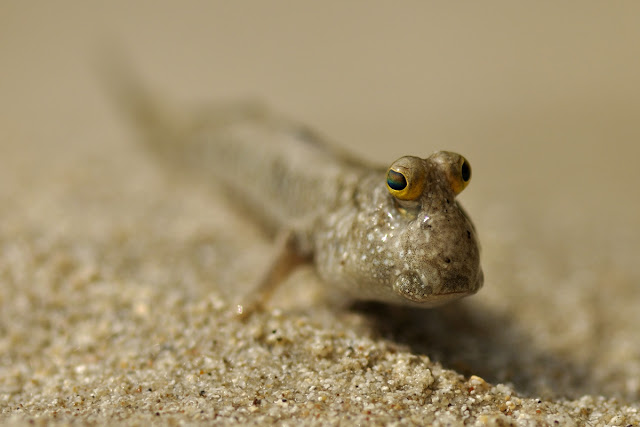
The little stream continued to battle with the Andaman Sea. High tide pushed water into the stream every time a big jolly wave lashed at the shore. And when a gentle wave followed suit, the stream melted into the sea. I walked along the stream to look for its source when I saw them. Mudskippers. They were everywhere. Brown. Speckled. Some golden. Small and big. Everywhere! Dozens of them waddled at the edge of the stream lazily, leaping away when I stopped to observe them. While some stayed at the top edge of the water with just their eyes popping out, others stuck to the bottom of the stream. The source turned out to be a small pond, with more denizens - Hermit Crabs, tadpoles and plenty of little fish. I found the driest spot by the edge of the water and settled down to observe and photograph them, up close.

Mudskippers are fish out of water, literally.They are completely amphibious fish and belong to one of the largest families of fish, Gobiidae. They have the ability to breathe through their skin and also the lining of their mouth. This means that they have to keep their skin moist at all times and that factor limits their habitat to humid and swampy areas. Mudskippers have an enlarged gill chamber which functions like an oxygen cylinder by preserving a bubble of air, helping them breathe while they are out of water. This helps them survive and adapt well to intertidal zones and mangroves.


While I sat there, taking in their looks and behavior, they approached me slowly, one skip at a time. A few were just an inch away from me. They were unbelievably curious and bold, staring at me with those big, bulging eyes. And, no, I am not imagining things, they really do stare, hard. Very aware of their close proximity to me, I slowly moved my arm to adjust camera settings and as things turned out, they didn't like that at all. They all leaped away in an instant. Skip up close, stare, jump away at the smallest movement. Repeat. The first few times this happened, an eerie, unsettling memory those little green Compsognathus dinosaurs in the Jurassic Park movie series crept into my head. Dismissing vacuous thoughts of mutant Mudskippers, I went back to work.


Mudskippers use their pectoral fins to walk on land, in a type of motion that resembles skipping. They use these fins to propel themselves ahead, to hop or jump. In all fish, pectoral fins occur in a pair, and function as forelimbs. And in a highly developed state, these fins enable some species to do very specific actions - they help Flying Fish in their flight and Mudskippers in their walking motion.  Male Mudskippers use their dorsal fins for displays during the breeding season and for solving tiffs.


Mudskippers spend a considerable amount of time outside water, on and in the mud. Their social interactions happen outside of water - mating displays, territorial fights, feeding, etc. While I mostly saw them just lazing around, there were a few of them here and there, fighting and feeding. Mudskippers mainly feed on insects, tiny organisms in the mud and small crustaceans. They dig deep burrows into the mud and stay in there at high tide, to avoid predators. They also lay their eggs in these burrows and the males diligently take care of their eggs by bringing mouthfuls of oxygen from the surface till they hatch.


However, the one memory of Mudskippers that will stay with me are those huge, bulbous, protuberant eyes on the top of their blunt heads. And when they sit around staring at you up close, its hard not to notice those fabulous colors -Turquoise, Yellow, Green, Red, Ochre, Black, Gold.


Their eyes are close set and movable. They pull either one or both their eyes into their heads and push them out in a brisk motion, as fast as one can bat their eyelids. It was fascinating to watch their eyes and the things they could do with them!


At some point around then I realized that I had lost track of time. My watch told me I had been there, watching these little guys, for almost two hours. But, they were not done with staring at me yet and I wasn't going to be bored anytime soon. Yet, the relentless heat and humidity on the island took a toll on me. All I craved for was to go sit in the sea, with only my head popping out, just like my new found friends. I bid adieu, thanking them for sharing their noon with me, and so graciously allowing me a peek into their peaceful lives.


Friday, October 26, 2012

Cinderella

It was a grey, damp evening. But, I had no reason to complain. The friendly neighborhood Shaheen Falcon was visiting again and kept me occupied for more than an hour. 

Ten minutes to midnight, I was preparing to sleep when I saw a mix of brown and white fluttering at the edge of the balcony railing. I assumed it was a bat, but the sound of the wings didn't seem like that of a bat's. The fluttering stopped in a few seconds and the mysterious visitor settled down. It was very dark outside, the moon wasn't out in full force yet, and the silhouette hinted at a little bird. I couldn't risk turning the light on, any quick movement could scare the bird. I ran away to fetch my camera and out of desperation, used the on-body flash to take a few record shots first. 


The camera revealed a very pretty little bird with rich brown-black markings on the wings and dark scales on the inner parts of the body and around the legs. Going by the size, shape, posture and the beak, I deduced that it could be a female/juvenile of a Robin/Thrush/Flycatcher, most probably in migration.

The bird was restless initially. It hopped around a couple of times, with its tail slightly up, making a faint krrrk-krrrkk call. It was a little skittish too, courtesy some noisy street dogs far below in the neighboring street. I was hoping that it would find a nice, cozy place and stay the night. And it did, like this ->


I watched it for 40 odd minutes and while the bird dozed away (I am guessing it did) I scouted for images and illustrations to try and put a name to the face. I sent images of the bird to friends and hit the sack. It was only the next morning when I was able to finally ID the bird, it was a female Blue-capped Rock Thrush (Monticola cinclorhynchus). The excessive markings on the wings and darker scales could be a result of long flights in the migratory season. When I checked in the morning, as expected, the bird had left.

Divya, Sridhar, Karthik and Shyamal - Thank you for your help!


Until next time, when Cinderella hopefully visits me again :-)

Monday, September 10, 2012

Quid pro quo

It is a bustling, vivacious world out there, is a thought I cannot evade every single time I am out in the wild. One could walk ten steps and observe a hundred different things happening at the same time. At sundown, a huge flock of Bee-eaters chirping, or a lone Pitta calling out mean the same thing - they are prepping to roost and retire for the day. But, that Nightjar clucking aloud at the same moment has just begun its day. A skittish Bulbul perching on a shrub could be very random behavior, but a Mormon picking a particular shrub to settle down on could mean something else. A bunch of Ants going up and down a blade of grass are definitely there for a reason and so is that Calotes hanging around an Ant's nest. For every unrelated event, there are a dozen related behaviors and for every behavior we think we understand, there are a dozen that we don't see or comprehend.

Relationships in the wild are mostly either obligate (where both species completely depend upon each other) or facultative (where they can, but they don't have to live together).

I once came across dozens of little insects, each the size of a mustard, clumped together under a leaf. They had some pretty red ants for company. I was later told that they are sap sucking insects called Aphids or Plant Lice. They are probably one of the most destructive insect pest species. The red ants belonged to the genus Camponotus and are commonly called Carpenter Ants. Aphids pierce leaves and feed on sap. Excess sap concentrates as honeydew, which attracts ants. In a display of Mutualism, the ants provide aphids protection from predators.The next time you see plant lice on a leaf in your garden, look around before you toss the leaf out. You might see the entire life cycle of a species on that very leaf!


Ants and Aphids


Mutualism is a co-operative interaction between two organisms of different species where they biologically interact and derive some positive benefit out of the interaction. However, this is not an obligatory relationship. Both species can function normally without this relationship. 

Watching ants and aphids peacefully co-exist together built enough curiosity in me to observe ants more. And that is how I was introduced to Mealybugs and Treehoppers. Mealybugs are scale insects, considered as pests since they feed on plant juices and can induce leaf drop when they occur in large numbers. They become very serious pests in the presence of some ants, as these ants protect them from predators - again, a display of mutualism.

Ant tending to a Mealybug


Ants and a Mealybug

Treehoppers belong to the family Membracidae, a group of insects related to Cicadas and the Leafhoppers. Some treehoppers have also developed mutualistic relationships with Wasps.


Ant tending to a Treehopper

Unlike mutualism, Parasitic relationships are non-mutual, where one organism benefits at the expense of the other. Mistletoe, strangler figs, leeches, fleas fall into this category.
Insects like fleas are external parasites, they are wingless and have mouthparts adapted for piercing skin of mammals and birds to suck blood. Leeches are also blood suckers, they feed on blood from vertebrate and invertebrate animals. 

Some members of the Mistletoe family are partial parasites. When birds like Flowerpeckers feed on the fruit of this plant, a sticky substance present in the fruits ensures that the seeds get stuck to their body. To get rid of these seeds, the birds rub their body against a tree, thus enabling seed dispersion - the roots penetrate the branch of the tree and the plant is born. The plant has green leaves and can photosynthesize, but absorbs nutrients from the host tree instead. Although the Mistletoe is a partial parasite, it is beneficial to the ecosystem, with a wide variety of species depending on the fruits. The plant is also a larval host for the very pretty butterfly, Common Jezebel.


Mistletoe Flowers

I find Strangler Figs fascinating, I think they add charm to a forest. Mostly found in dense, tropical forests, these plants begin life as epiphytes. Birds and other arboreal animals act as seed dispersers for these Ficus plants and they grow on top of other trees, by germinating in crevices on branches. The seedlings then begin their journey downwards, looking for necessary nutrients and simultaneously grow upwards into the sky, in the quest for sunlight. In the process, the original host tree is enveloped and often dies. As they grow, the fractals these roots and branches assume look eerily beautiful. I have seen the most spectacular specimen of Strangler Figs in Bhadra Tiger Reserve and Jim Corbett National Park.  


Strangler Fig from Bhadra

A Symbiotic relationship, on the other hand, takes place between two species where they completely depend on each other for survival.
Symbiotic relationships can be broadly classified into Ectosymbiosis - where one organism lives on another (mistletoe, lice, cleaner fish) and Endosymbiosis - where one partner lives inside the other (zooxanthelles in corals, lactobacilli in humans)

Lichen, for example, is a composite organism which is formed as a result of a symbiotic relationship between fungi (mycobiont) and a photosynthetic partner, usually green algae (phycobiont). Algae can photosynthesize by virtue of being a plant. Carbohydrates are produced during photosynthesis, which in turn serve as food for the fungi. 


Lichen

Lichens (rock flower) are some of the oldest living organisms on Earth and can survive in varied climates and altitudes. They grow on any undisturbed surface that receives ample light - leaves, branches, bare rocks, walls and exposed soil surfaces. Many lichens are vulnerable to environmental disturbances and their growth is inhibited in such cases. So, they can be observed to assess air pollution. They are used to prepare dyes, masalas and some medicines too.

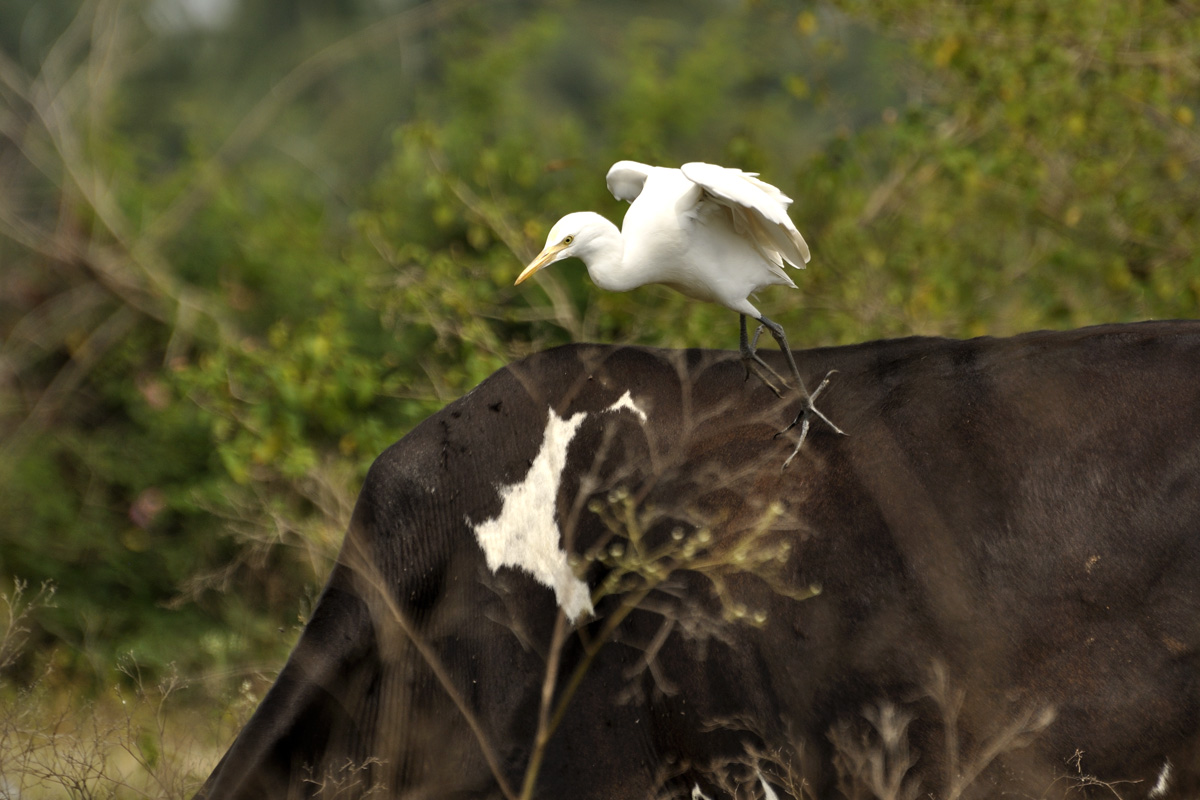
Cattle Egrets following a herd of grazing cattle is a common sight in most suburban parks and villages. In forests, we see these Egrets around herds of Elephants, Deer and Gaur. They spend time around these large mammals feeding on insects and other small prey that are disturbed while they graze.
This type of a relationship is called Commensalism. The word originates from the term 'Commensal' which means 'sharing of food'. Here, one organism benefits but the other doesn't - and it is caused no harm either. 

Cattle Egrets with a herd of Elephants

All bonds in the ecosystem are delicate and sensitive, they hang by a thin silken thread. The loss of one species in a relationship can spell disaster for the other species too. They give and take, but just the right amount, to maintain and enrich that critical equilibrium. While we know of and understand some of these connections and inter-dependencies between species around us, there are many that aren't even visible to the naked eye, that are still being studied. Many of these relationships have heavily influenced evolution.

We humans are social in nature and live in a sea of relationships - we are born into many, we build several, we are forced into some, we love being in a few that we care about and hate being in those we become hostages of. We are capable of developing close bonds with anything or anyone we spend a considerable amount of time with. We are constantly wriggling in and out of relationships, pretty much like all other forms of life we share this planet with. However, there is a difference. Humans can never achieve the kind of complexity in relationships that non-human forms of life can.


P.S Thank you, Karthik for helping me put mind and matter in a reasonable order :)

Wednesday, November 2, 2011

Unsung and Unheard

Some decisions are tough. More so when it involves walking through a dense jungle in the dark night, just to check on the sound of tree felling. One could step on a snake, slip on a rock or fall into a pit, and this is elephant – tiger country. Narrating how they walked a couple of kilometers in the middle of the night, Forest Officer Prabhuswamy recalled how they couldn’t even turn on the torch, for they could end up alerting timber smugglers about their presence. He, along with a couple of other watchers - Jayendra and Soma - recently caught a few timber smugglers. These courageous men don’t have a choice to make these decisions. It is their job, their call of duty and come what may, they will protect their home – the jungle.


40 year old Jayendra, a native of Coorg, joined the forest department as a MR (muster roll) Watcher in 1987. He continues to be an MR Watcher in 2011, with no hope of ever being promoted as a permanent watcher. Every morning, armed with a rifle and a wireless phone, he sets off with two other guards to patrol the forest and visit all the sensitive areas – forest state borders, caves and waterholes. He can get two days off once in ten days and he uses this time to visit his family in Bandipur town. His children attend school there and like all other guards, he is worried that with lack of guidance, his children too will drop out of school by the time they reach the 8th grade. 


46 year old Soma, on the other hand, is a PCP (Petty Cash Payment) watcher and joined the department 11 years ago. His young daughter was married off to the first suitable match last year, Soma says wanted to reduce his burden. He is on the same lines as a daily wage worker and is aware that he will never be added to the muster roll, he belongs to the pool of lakhs of such PCP workers across different government departments and their fate hangs on a pending bill in the parliament.  


Across 11 ranges and 38 anti poaching camps in Bandipur, there are around 250 PCP watchers and 57 MR watchers. All of them share the same plight as Jayendra and Soma, and some, worse. Their work is anything but hard, it is somewhere much beyond that - walking for an average of 15-17 kilometers each day, battling forest fires, helping villagers chase away elephants that enter fields in the fringe areas, taking on poachers and timber smugglers, to mention a few. Job insecurity, tough working conditions and the fact that they live deep in the jungle, isolated from the world and far away from their families doesn’t help the situation. These problems are magnified in the summer when the heat reaches its peak and the forest runs dry; and in the monsoon when incessant rains take over the landscape. Unappreciated, insecure and demotivated, they truly are THE unsung heroes. 


The APC (Anti-poaching Camp) we visited is one of the better ones, there is a concrete structure with a proper roof, a separate chamber to store supplies and a trench around the cottage to keep the elephants at bay. It has an approachable road and the forest department jeeps can access the APC with ease. A tiny bulb hangs there, powered by a solar panel on the roof. However, things 
that we take for granted, like water supply and toilets are still a luxury. The hand pump of a bore well installed there was damaged by an elephant, so water has to be supplied in forest department jeeps, 45 liters once in three days.  But, there are many APCs in interior parts of the jungle that are not easily accessible, especially in the monsoon. In such places, forest guards still live under leaking roofs, without electricity. 


Mr Hanumanthappa, the DCF of the Bandipur range says that the living conditions of forest guards have largely improved since Project Tiger came to Bandipur - funding improved, uniforms and shoes were distributed, salaries became regular and food supplies increased. They are now given nutritious food and food provision has been increased from Rs 20 to Rs 40 per day. They now have enough rations for two meals a day and have been provided bags and water bottles to help them carry food when they go out for their daily patrols. The DCF pointed out that the guards need binoculars, jackets and umbrellas. The fire fighting staff require shoes, knives, torches and some masks to protect their faces from the fire and smoke. He has been trying to procure these items for his staff.

The forest department maintains a list with data of unemployed youth from local villages and contacts them when they need to increase their workforce. Some children of forest guards have also joined the forest department in similar roles. But, given the working conditions of these guards, their children have no motivation to take up jobs within the forest department, which has resulted in a huge shortage of staff. Outsiders will not last in this jungle, he says.


Yes, this also means that guards in any forest range which is not a Tiger Reserve don’t receive salaries for months. They live in very bad accommodation and patrol the jungles in rubber slippers, armed with a stick. Most of these guards are tribesman or locals from the fringes of the forest, with excellent knowledge of the jungle. They can track and guess human/animal movements in the jungle through a broken branch or footprints, information that can be very valuable to a poacher. There is always a threat of loss of loyalty. Vital information could leak out either innocently or for monetary gain. Some sort of commitment or attachment to a forest officer is the only factor that keeps them going.

Many NGOs have arranged general health check-up camps and provided first aid kits. The guards did admit to us that they don't know what medicines to use, as many of them can't read. Some guards from local tribes are not comfortable wearing shoes but wearing uniforms motivates all of them, they said.


The Kumble Foundation is working towards providing long-term solutions to some of these core issues. With an aim to improve the general health condition of the forest guards, they have collected details of health and medical support requirements. They intend to set up a group insurance for all the guards including temporary employees. Proposals have been made to the government too. Diinesh Kumble says, they are keen on supporting children of forest guards so that they can get vocational training, guidance and counselling once they complete their basic education. The Foundation is also looking for genuine requirements of assistance for higher education on a merit basis. The Jumbo Wildlife Award and Jumbo Fund have been set up with an initiative to reward wildlife champions and recognize the contribution of forest staff, researchers, NGOs and civil servants towards conservation. 

In a jungle that has a rich diversity of species and is constantly in the spotlight with three states fighting over some space on the highway, it was eye-opening to meet the heroes who run the show silently. A vehicle passes by this road every 47 seconds, lakhs of people traverse the road every day. Yet, the tale of these guards is mostly untold. They desire very little - appreciation, security, family time ... and a ear if you can lend one, for, they have a story to tell. 

P.S Thank you Diinesh Kumble and Shreyas Jayakumar for facilitating this meet.

Banded and Branded

We were busy looking for Treepies and Trogons when the call came. A King Cobra had been sighted in a farm and the residents of a nearby house wanted it to be relocated to the forest. The ARRS team was off to rescue and release the King. Did we want to go along and watch? Yes, we said. A huge YES.

Belagundi is a quaint, pretty village a little away from Bidri, about 25kms from Agumbe. As we drove down the ghats, we saw Prashant, Ajay and Dheeraj stop to pick up a semi-dead Ornate Flying Snake from the road. It was a heart-rending sight to watch the tiny, beautiful snake wriggling on the road. Its slender body had been crushed by a vehicle. We drove on, the Seetanadi river flowing along the road, lush green forests and areca plantations dotted the landscape. At Belagundi, we got off the vehicle and walked into a field, a small group of 10 odd people had gathered there, mostly local residents and some workers of the farm. They led us to a tiny stream by the edge of the farm and pointed at the location where the King had been resting the last two days, but now, only the tip of the tail was visible, the King had moved into some shrubs by the stream.


As the ARRS team moved around, to get a better view of the King, it struck me that these people had waited two full days to call and ask for help after they spotted the King. There was a house about 50 metres away from where the King had been spotted, there were children in that house. Yet, they waited, patiently, without disturbing their guest. Moreover, everyone there was concerned that the King could be injured as they didn't see it move around at all. Prashant explained that it is a possibility, or, it might be resting after a heavy meal - a big rat snake maybe? They would be able to confirm only after they see the King in its entirety. The concern they had for the King's well-being was touching. My heart swells with pride when I think of how tolerant and respectful these folks were about wildlife. 

The King Cobra is worshipped in these parts, these people revere the snake. They will cause no harm to the longest, most venomous snake in the world.


Once they were able to locate the exact position of the King, they got to work. First, they cleared up the area where they would eventually bring the King out of the shrubs, so that they don't have any obstructions. All tiny bushes were removed, working space had been created. The team advised everyone watching to maintain a safe distance, not move around and maintain silence. While one person kept a constant watch on the head of the King, another held the tail and with a mild jerk, prodded the snake to move.


The King moved and we could now see more of its body, but no one had a clue of the actual length and size yet. More nudging, coaxing, pulling and the King was finally out. I gasped aloud, but I wasn't alone - a collective gasp from the crowd greeted an irritated King. A glinting blackest-black body with golden-bronze bands and a rich yellow underbelly, the 10 foot long juvenile male was a stunner, albeit in a compromised position at that moment.


He constantly flicked his tongue and moved around, clearly trying to find a way out of this ugly situation. Accuse me of being anthropomorphic, but who wouldn't get intimidated, scared and angry if they were being taken captive? Prashant held on to the tail, a tight grip and his attention was entirely on the movements of the snake. Dheeraj tried to cover the head of the snake with a bag that had an opening like a net, so that the snake would be forced to slither in and could be captured.


The first couple of attempts to get the King in the bag didn't work and that's when he started showing signs of agitation. He raised his hood and that magnificient pose is something I will remember all my life. The crowd watching this capture was enveloped in silence, no one moved, all the murmuring died down.


And then it happened, the King bared his fangs.


A sight that filled me with amazement, fear, respect, worry - all at once. Amazement, because I've always associated sights like these with Austin Steven's documentaries. Fear, well, the image explains it all. The King would not give up and go down, he would fight his way through this, Respect. Once released, would it find a safe spot away from human intervention? Would it be able to survive on its own in a new place? Worry.


Prashant and Dheeraj were finally able to coax the King into the bag. Once the snake was in, a knot was secured, ready to be relocated. They worked together as a team with superb precision and composure.


The King was then weighed and he turned out to be 8.9 kilograms. We all headed back towards the nearby forest patch, adjoining the Someshwara Wildlife Sanctuary. After ensuring that the habitat was perfect for the King Cobra and that it was a safe distance away from any human intervention, the snake was released in the forest.

A relatively simpler task now - the knot was removed, some coaxing and the King headed out of the bag into its new home, or maybe it was the same old home, we will never know.


Once he was out of the bag, he moved away, graciously, down the forest path and into the leaf litter far away from us.


The entire rescue-release operation was carried out very professionally by the ARRS team. They were meticulous and followed all procedures to the last detail. Prashant said this was one of their simpler, easier rescues. Now, try and imagine a King being rescued from a well, or from a house. Goosechills. 

The love-hate relationship between humans and snakes is something we all see everyday around us. A Rat Snake in the local park gets mistaken for a venomous snake and is beaten up by an angry mob. An Indian Cobra that wanders into a township meets the same fate. Russel's Vipers get crushed under wheels all the time. Snakes are seen as bad and dangerous creatures, as villians. For most people, the first instinct upon seeing a snake is 'kill it'. Ironically, snakes are worshiped by almost all communities through the length and the breadth of the country. Yet, when the same people encounter a live one, things change drastically. Numerous and varied religious superstitions - mostly negative ones - about snakes definitely don't help the situation. 

On many occasions, people take the help of trained/experienced snake rescuers, who capture these snakes and release them in nearby jungles. The snakes live to see another day, but it is impossible to say that these relocated snakes survive. In a new, unknown location, with no idea of what kind of prey is available, disoriented, many snakes perish. If they do manage to find food, they need to deal with other resident snakes, who may not be too kind to their new visitor. So, the snakes are at the receiving end, always.

We can only hope that with more awareness, humans will start treating snakes with the respect they deserve and will let them live. We need these beautiful creatures, the ecosystem needs them, to maintain a balance. They don't need us.


P.S. Thanks Arati Rao for the title!

** I own the copyright to all the images in this post. Please do not re-use any of these images without my permission.

Monday, May 23, 2011

The King And I


I wrote this as a guest post for Prashanth's blog Payaniga upon its five year completion. It then appeared in the Clay blog too. Now, its here. 


My first memory of Agumbe is from a school trip to the Western Ghats. I was in class 8 and the famous Agumbe sunset was to be the highlight of the trip. Heavy rains and a landslide played spoilsport that year and Agumbe was moved to the ‘visit someday’ list. 15 years later, my wish came true. Dilan Mandanna, popularly known as Mandy, was going to organise a two day trip, with accommodation arrangements at the Agumbe Rainforest Research Station (ARRS). I simply had to sign up. I could finally put my newly acquired macro lens to some good use. After a successful leopard-tiger-elephant-hornbill-falcon sighting in Kabini the same week, I was looking to achieve nirvana with a sighting of the King.

Agumbe is a beautiful little village that sits on a plateau on top of the Someshwara Ghat, 643 meters above sea level. Surrounded by luscious green rainforests, it is known as ‘Cherrapunji of the South’ for a reason, it gets an annual rainfall of up to 11,000 mm. Agumbe is home to all the Western Ghats rainforest species of trees, mammals, birds, insects, frogs and snakes. However, the regal King Cobra, the world’s longest venomous snake is the King of the jungle in these parts.

A mad dash across the Majestic bus stand and a rickety 10 hour bus drive took me to a very rainy and wet Agumbe early in the morning. It had rained there all night. Aching muscles were forgotten the second Mandy announced that he had seen a male King the previous evening and was quite sure we’d be able to see him again. After dumping our bags and donning leech socks, we headed out to find the King.

His Highness was resting there, by the side of the forest path, right outside the bushes - 10 feet long, a rich brown, his scales glistening with raindrops, body all curved up as if to camouflage the inimitable length. He had devoured a heavy meal the previous evening and didn’t seem too keen to move, he just kept a watchful eye on us. In all my imagination, I had envisioned the King to be a spectacular snake, but nothing could have prepared me for this sighting. Goose bumps. Breathlessness. Loss of speech. Fear. Respect. I felt a mix of everything. I just stood there, gaping, with my mouth open. The beauty of the King is incomparable. The sound of a camera shutter next to me brought me back to reality, I had a camera in my hand to make an attempt to freeze this moment. Photographing the King is humbling, you are fully aware that you can do no justice in saving that intimidating stare for posterity, yet, you just go click-click-click.


The King Cobra has a striking distance of 2 m, around 7 feet, they are fast and agile. When threatened, the King raises its upper portion of the body, around 4-5 feet, so it basically looks at you straight in the eye and gives out a hiss that’s almost a growl, before doing its business. But, the King doesn’t like to bite. As much as possible, they avoid confrontation, they bite only when cornered or provoked. Before I forget, there is no antidote to a King Cobra bite.

ARRS was set up by Romulus Whitaker and has been operational since 2005. Many herpetologists, conservationists and researchers work on their projects based out of this research station. ARRS helps out in King Cobra rescues around the region. Though King Cobras are revered, they’re prone to some harm from humans when they venture into human settlements. Among many other projects, the King Cobra Radio Telemetry Project is currently operational here. With the help of telemetry, the researchers study snake movements. They record daily and seasonal activity patterns of King Cobras which helps in understanding their behaviour and eventually, in conserving this flagship species. The ARRS has a common dining area and common bathrooms. Serve your own food, wash your plates, don’t leave behind any plastic and give the staff their space to work is the way of life if you are a visitor.

It kept raining the entire day and we headed out to look for the King’s courtiers. A Green Vine Snake clung to a twig, completely camouflaged. Our presence brought out the black and white under its scales, a sign of aggravation.


A Malabar Pit Viper sat pretty in the bamboo, only a watchful eye can spot it, the shiny yellow scales give it away. It curls up into an S shape, defensive, its striking position.


A few steps ahead, an incredibly cute baby Nilgiri Keelback (Beddome’s Keelback) greeted us.


At every step we met wondrous new creatures - frogs, caterpillars, dragonflies, damselflies, butterflies.

caterpillar of a moth belonging to the Limacodidae or Euclidae family

The flora and fauna is so rich that you can spend an entire day photographing things at a single spot and you would still not be done with it.


A Malabar Trogon called for its partner, Yellow Browed Bulbuls zipped past our head. A Paris Peacock skimmed along, a Red Helen followed course. A Malabar Giant Squirrel dropped half eaten figs on our heads. A Crested Serpent Eagle called, gliding high up in the sky. I was in paradise.

Red Helens

Red Pierrot


White Bellied Treepies called out to us, so did Malabar Grey Hornbills. We went crawling across a huge field to shoot Malabar Larks and they took off before we got our best shots.


One evening, we made a trip to the Jogi Gundi falls. We walked under trees that made us feel like we are a few cms long, climbed over fallen trees, stepped over rocks, slipped down some leaf litter and reached a lovely waterfall with creamy white water gushing down the rocks. 


Green colored moss-laden rocks, wild orchids, lizards and frogs added to the beauty of the scene.


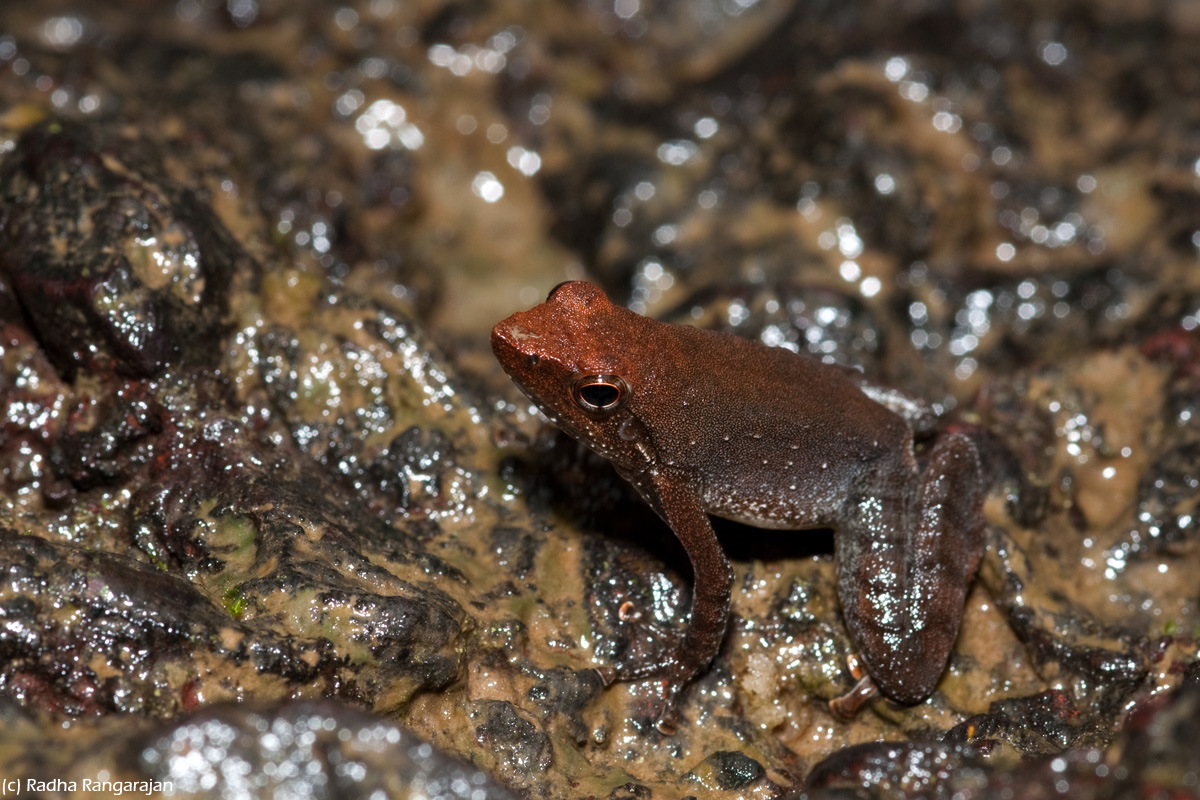
Micrixalus saxicola


And leeches. They were everywhere, crawling up our leech socks till we flicked them away, on our bags, cameras, there’s no getting away from them. The only way to not let them bother you is by not paying them any attention, alas, I am yet to reach that stage. I’ve had my share of experiences with leeches in Valparai, but the sheer number of leeches here was distracting. Much to the amusement of everybody in the group, a leech made its way to my camera neck-tag and then on to my cheek and gave me a peck before I managed to flick it away. As morbid as it sounds, yes, I’ve been kissed by a leech!

It was a cloudy, rainy day and we didn’t expect to see the Sun set, but we still went along to the sunset point to check out the view. As expected, the clouds had taken over the valley and every time they drifted apart, I tried to get a couple of images. Finally, the shy Sun made a brief appearance before the clouds took over completely.


If you are staying at the ARRS, a night walk is a must. Agumbe is an entirely different person at night. It gets insanely dark and all kinds of creatures are up and about. Armed with torches, we set out to look for snakes, scorpions, tarantulas and frogs. One of the first things we heard was a female Sri Lanka Frogmouth calling and we followed its call for quite some time before we spotted the elusive beauty. Mandy told us that no Frogmouth images had ever been made in Agumbe, our records of the sighting would be the first.


Typical to rainforests, you can find exotic fungi at every step.


A vine snake was hanging around the evening before we left, it bid us adieu.


It was pack-up time already. We drove past ‘Dodda Mane’, Malgudi Days was filmed here and the ancient bungalow was the home of the endearing little Swami. On the way back to the ugly urban jungle, I promised myself that I would return to Agumbe, for a longer trip, knowing that no amount of time spent here can be enough. 

Until then and forever, there’s one image that will remain etched in my mind from this wonderful trip. 


The King’s stare.


** Please do not re-use any of these images without my permission.